
It’s quiet isn’t it? Mid-afternoon, I’d say, on a nice day. The tea rooms are open, the Open Sign is out and the front door open. It’s warm and the windows are open and the awning wound down. A lazy afternoon.
This postcard was posted on Tuesday 12 May 1964 from Poole in Dorset and sent to Chesham in Buckinghamshire. The writer too records a “lovely warm day” but was not travelling in anything as fancy as a convertible Ford Zephyr as seen in our postcard. She is a coach traveller and tells her friend that she went to Ringwood on Monday. I wonder whether she visited the Old Cottage Tea Rooms for an egg and mayonnaise sandwich cut into triangles and a scone with clotted cream and jam. I expect so.

The Mk2 Ford Zephyr was produced between 1956 and 1962. Base models were badged Consuls and higher spec, six-cylinder models Zephyr Zodiacs (later just Zodiacs). These were all of unitary construction (i.e. without a separate chassis) and Ford never made their own convertibles. Instead, they subcontracted the work to the Coventry-based coachbuilders, Carbodies.
I think the stainless steel detailing beneath the rear lights make this a Zephyr as Consuls didn’t have it and Zephyr Zodiacs had brightwork all along the back.

Simple Consul rear.

Zodiac rear.
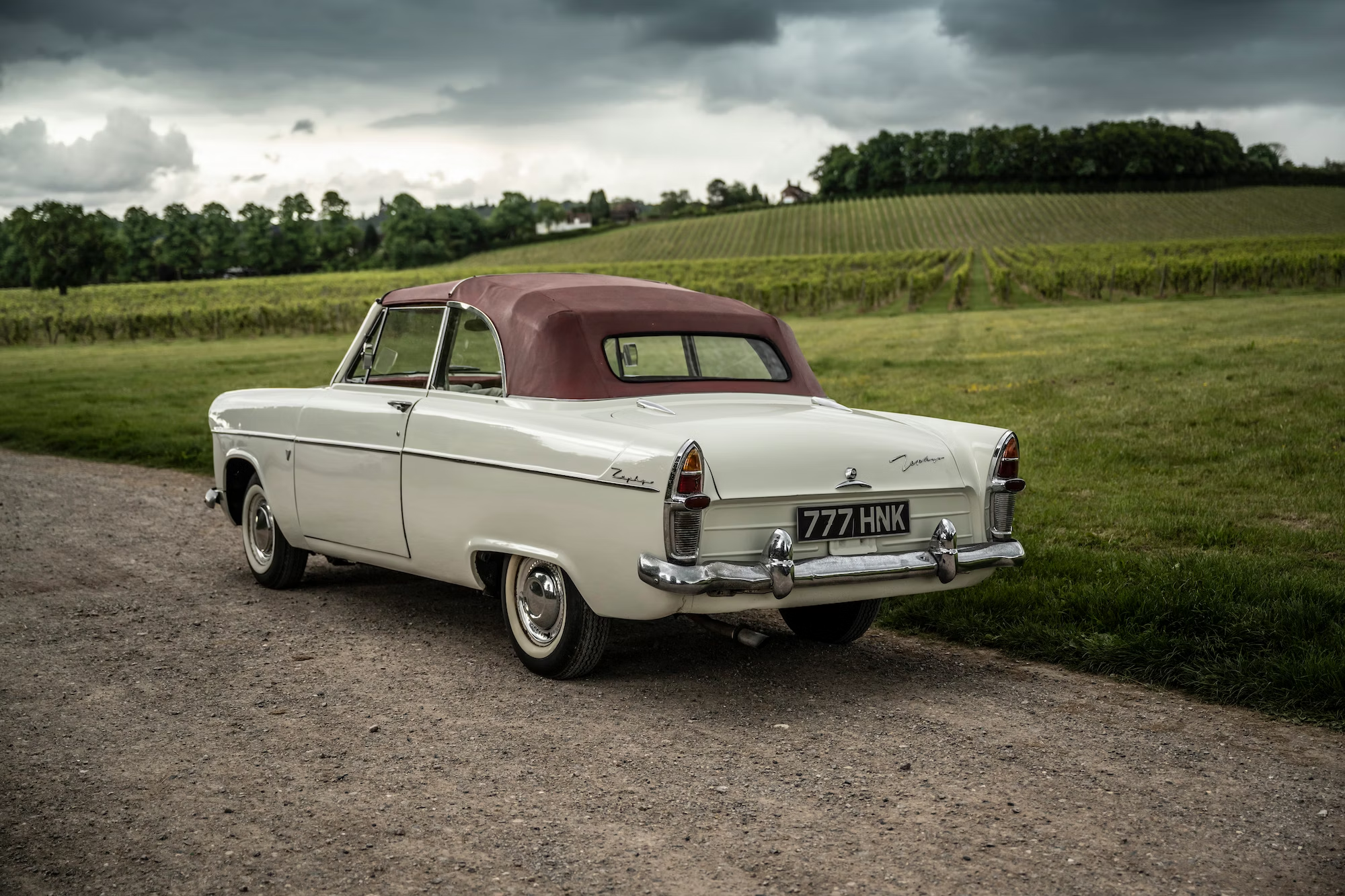
A Zephyr rear end similar to the one in our postcard. The rear lights on all three cars are different, but maybe these changes were applied to all three versions over time?

Four years before our postcard was posted and a couple of hours drive north in Chippenham, this Mk2 Consul left the road with tragic consequences. It is pictured here after being towed away from the crash site.
In it were five people including the singers Gene Vincent and Eddie Cochran. Gene and Eddie were sitting in the back with Eddie’s girlfriend the songwriter Sharon Sheeley and all were thrown out of the car in the accident. Eddie suffered head injuries and died the next day in hospital never having regained consciousness. Gene and Sharon suffered relatively minor injuries and made full recoveries. The driver and front seat passenger were not badly hurt.
Much of the strength of the car is in its unitary body and as can be seen from the photo, despite the body breaking apart before the rear wheel and the C-pillar snapping, the passenger cell did remain fairly intact. However it wasn’t until 1987 that new cars had to have rear seat belts fitted in the UK and not until 1991 that the wearing of seat belts in the rear became compulsory. Too late for Eddie unfortunately.
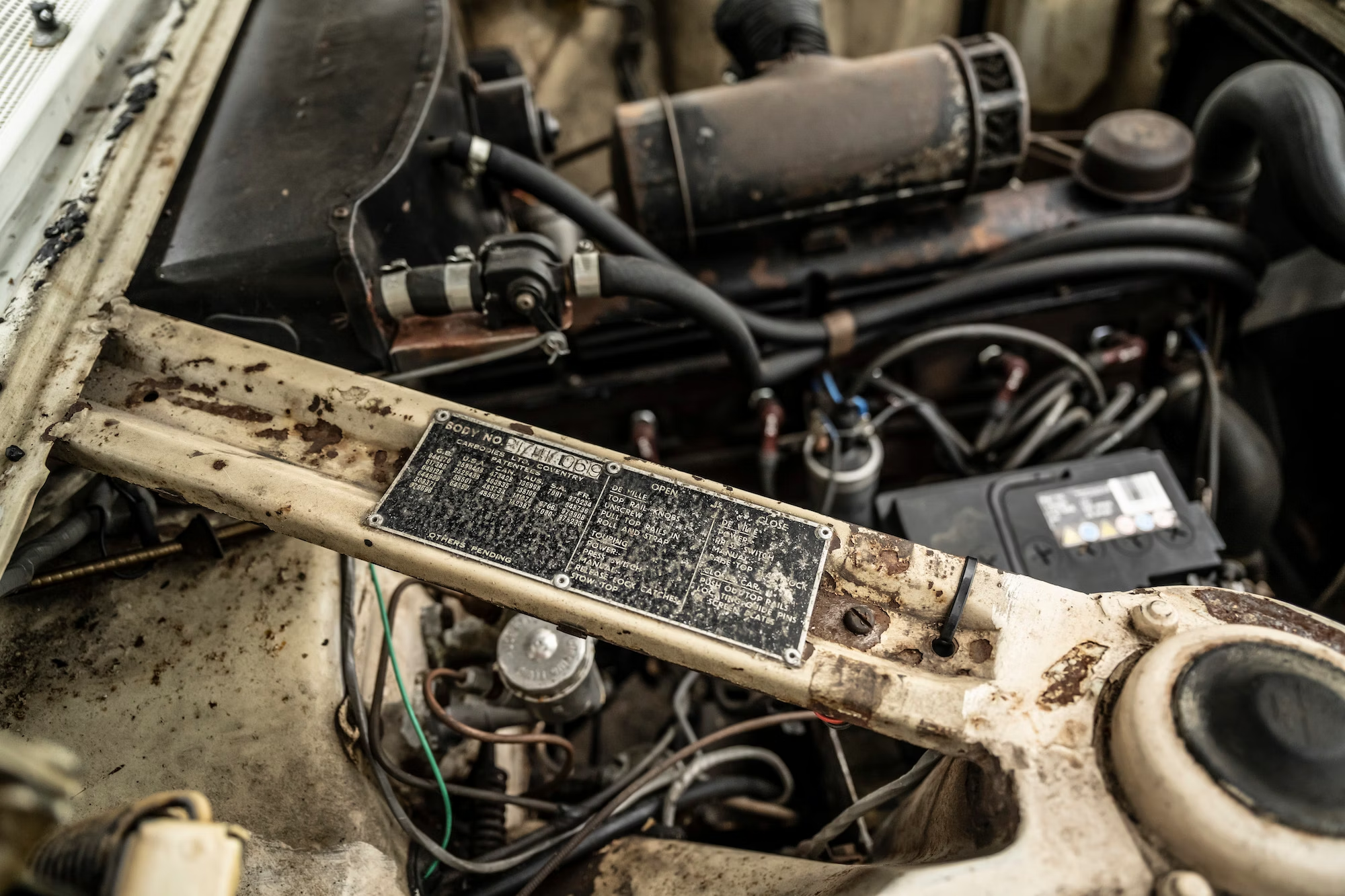
When Carbodies cut the top off the Zephyr they had to strengthen the lower half of the body to stop it flexing and breaking in half in the event of an accident. When I saw this bracing under the bonnet of a Zephyr Mk2 that was sold by auction in 2022 (for more photos see Collecting Cars) and noticed the Carbodies plate on it, I thought this was a Carbodies addition, but not so. All Mk2s had these strengthening pieces when they left the factory.

Under the bonnet of a 1957 Zodiac (from Studio434) showing the same braces.

The Carbodies plate lists its patents and the operation of the power hood, which could be set in a De Ville (half open) position or a Touring position (fully down).

This is not the first convertible Mk2 Zephyr/Zodiac to have appeared in a postcard in this blog. Do you remember this one?

This lovely car appeared in a post titled A Zodiac in Hungary and like our Zephyr convertible sports a GB plate. It was probably a very comfortable grand tourer in its day. I like to think our car was on its way to or from Poole Harbour, the gateway to a Continental touring adventure when they stopped for a cuppa at the tea rooms.
Now for a little trivia.

The Consul/Zephyr/Zodiac Mk2 shares an odd little feature with this car – the BMW E3. Anyone know what?

The Mercedes 220 SE also had it.
(clue: It’s hidden and can only ‘not be seen’ from the rear)
Sorry but I don’t know the answer to your query.
My very first holiday “abroad” was a flight to Jersey with three friends in 1964 or 65. I hired a Ford Consul convertible for the week and we visited and posed at most of the “in places” on the island. Unfortunately the weather wasn’t too good but we still had the roof down most of the time.
Brilliant! Have you got a photo? Would live to see one and add it to the post. You can send it to info@postcardsforpetrolheads.co.uk Merry Christmas, Martyn! Long time no see!
Fuel filler behind number plate?
Lovely picture, Bob – so English – and in the seventies when I’d first got my driving licence, this is the car I really wanted.
The strengthening arms in the engine compartment braced the tops of the McPherson struts which would otherwise have had to rely on the rigidity of the box-sections that formed the front wings and valence. Though later Fords did exactly that, these were early days for both unitary construction and the use of strut type front suspension so the Ford engineers were probably a bit wary of relying on the strength of just the fabricated sections, and probably with good reason. Belt-and-braces, you might think, but early uni-bodies were frequently over-designed. So these Fords were fine – until the cup sections that mounted the tops of the struts rusted through (which they did)!
Yes, well done! I was interested in your observations about those early Fords with McPherson struts (I think the Mk1 Consul/Zephyr was the first to use them) and how designers were wary of putting all those forces straight into the body. Thanks for your comment. Merry Christmas!