
It’s been quite a while since I wrote up one of my postcards, seven months in fact, and at least two regular readers are grumbling. One of those regular readers pointed out that he has become an irregular reader from no fault of his own. So, let’s look at this postcard from Germany.
The postcard is unposted and is from a town called Lutherstadt Wittenberg, the ‘Birthplace of Protestantism’ and shows the 16th century Rathaus (town hall) overlooking the Marktplatz.
Writing up this postcard has been like unravelling a tangled ball of string and the result is a rather rambling, disjointed narrative and much trivia, but that is not so unusual in this blog.
Where to start?
Let’s look at the back of the postcard. I had thought that the Cyrillic script dated the postcard to the period after the Second World War when Lutherstadt Wittenberg was in Soviet hands – from 1945 to 1949 when the city became part of the newly formed German Democratic Republic (GDR). However, the presence of mid-Fifties cars contradicts this assumption and suggests the postcard manufacturer retained the Russian translation even after the formation of the German Democratic Republic.

I know we are not here for a history lesson, and I am the least qualified person to give one, we are here for the cars. However, history and geography play a big part in understanding the cars parked so haphazardly in the Marktplatz in our postcard. So lets start with some dates.
Dates
1541 The Rathaus was completed in 1541 before there was a country called Germany.
1919 – 1933 From the end of the First World War Germany was a democratic parliamentary republic commonly known as the Weimar Republic.
1929 – 1933 The Great Depression was particularly devastating for Germany during the years 1929 to 1933 and German car manufactures struggled to survive. A solution for four manufacturers, Audi, Horch, Wanderer and DKW was to combine to form a conglomerate in 1932 – Auto Union.
1933 The Third Reich came into existence in 1933 and lasted until the Second World War ended in Europe on 8 May 1945.
1945 – 1949 After the war Germany was divided up into four occupation zones, each controlled by one of the allies – the USA, the UK, France and the Soviet Union. Lutherstadt Wittenberg fell into the Soviet zone. At first travel between the zones was unrestricted and people were free to choose where they wanted to live.
1949 The idea at the beginning was not to create two countries but the occupying forces could not agree on how to manage Germany. In May 1949 the western allies formed one country from their zones and called it the Bundesrepublik Deutschland (the Federal Republic of Germany). In October 1949 the Soviets followed suit and created a new country of their zone calling it Deutsche Demokratische Republik (German Democratic Republic).
Geography
German car manufactures after the war sometimes found themselves split with plants in different zones and later in different countries. When they resumed production, taking pre-war designs as their starting point, the split companies developed their cars in different ways as we shall see.

The Cars
Let’s go left to right.
EMW 340
The first car is an EMW 340, maybe a BMW 340, but probably an EMW.
We’ve all heard how the division of Germany after the Second World War divided families and so it did with companies. BMW (Bayerische Motoren Werke or Bavarian Motor Works in English) had a factory in Eisenach, about three hours drive south-west from Lutherstadt Wittenberg and after the end of the Second World War production of BMWs resumed there under new Soviet management.
The management in BMW’s head office in Munich were not happy, not only had the Soviets resumed BMW car production before them, they were not happy with the BMW name being applied to the Eisenach car.
Things were resolved in 1952 when the Soviet Union handed over ownership of the Eisenach company to the newly formed German Democratic Republic and the two German management teams agreed that the Munich enterprise would keep the name BMW, the B for Bavaria (Bavaria fell in the American sector so was in West Germany) and also the blue and white badge, whose colours represented Bavaria, while the East Germans agreed to change the name of their cars to EMW for Eisenacher Motorenwerk and change their badge’s colour to red and white, presumably to reflect the socialist nature of its country.


As a by-the-by, I was in Germany last month and came across a BMW Z4 M in Dinkelsbühl that had a badge that was both red and blue. This was used on M cars in 2022 to celebrate 50 years of the BMW M division.

Anyway, back to the postcard. So, the car on the left in our postcard might be a BMW made in Eisenach if made before 1952 or an EMW if made after that date. EMW 340s were made up until 1955. Of course it might also be a later BMW driven from West Germany into East Germany, but I’m going to assume it is a locally manufactured EMW.
While reading up about EMWs I came across this interesting YouTube video which I will share with you. Even if you cannot understand German it gives a great impression of the EMW 340.
The car to the right of the EMW 340 is a Wartburg 311.
Wartburg 311
Wartburg was a marque produced by Automobilwerk Eisenach, which, as mentioned, also produced the EMW. It was named after Wartburg Castle where Martin Luther translated the Bible in 1522 and which overlooks the town of Eisenach where the factory was.

The red and white Wartburg estate car, or ‘Camping’ as Wartburg marketed the estate version, appears very flamboyant, modern and American-looking with its two-tone paintwork.
If the postcard was printed a little better and the photograph taken from a slightly different angle we would be able to see something else that makes the Wartburg 311 Camping stand out from the crowd. It had rear side windows that curved up into the roof, which itself had a sliding fabric sunroof making the rear of the car particularly airy and also practical, in that long objects could be stuck out of the top if necessary.


By the mid-1950s the Eisenach factory was moving away from its BMW-derived, six-cylinder cars towards the smaller DKW-derived two-stroke cars which were not only cheaper to produce, but were a better fit with the Soviet ideology of providing cheap cars to more people rather than more expensive cars to only the few who could afford them.
The two-stroke IFA F9 ( we will come to this in a minute) had been produced at Eisenach since 1953 and was succeeded by the Wartburg 311 in 1955/56. EMW 340 production finally ended in 1955 after a few months when it and the IFA were produced alongside each other.
Cylinders, strokes and capacities.
Under the bonnet these two cars, the earlier EMW and the later Wartburg, could not be more different. The EMW had a two-litre, straight six, four-stroke engine while the Wartburg had a 901cc (later 992cc), three cylinder, two-stroke engine. Another big difference was that the EMW was rear wheel drive, while the Wartburg was front wheel drive.


To the right of the Wartburg is a small pre-war car, but I have no idea what it is. Anyone? The view of the car is confused by the overlapping presence of the Wartburg. Initially I thought it had very thin wheels, but then realised that what appears to be a wheel is, in fact, part of the red and white car. Now I cannot un-see that thin wheel!
Mystery car

To the right of that, the two-tone blue and white car is another Wartburg 311, this time a saloon. Wartburgs at that time had a separate chassis so creating variants of the 311 was relatively easy. In fact they also produced two-seater and four-seater convertibles and in a blog post a while back I featured a Wartburg 311 Sportwagen (see below).


DKW / IFA
The next car, with the distinctive chrome strips on the boot is either a West German DKW 3=6 or its East German cousin the IFA F9.
When production resumed after hostilities ceased, there were Auto Union DKW factories in both the Soviet zone and the British zone. Before the war Auto Union was producing the popular DKW F8 and planned to replace it with a more rounded, modern-looking F9, but because of the war the F9 was not put into production. After the war the F9 prototype was developed separately by both the Dusseldorf factory in the British zone and the Zwickan factory in the Soviet zone and later production of IFA cars was transferred to Eisenach.
The F9 is sometimes referred to as a DKW and sometimes an IFA. IFA stood for Industrieverband Fahrzeugbau and was an East German conglomerate of vehicle manufactures, DKW being one.


More names and badges
9=6 is a strange model designation but Saab had a 9-3, Lotus an Elan +2 and Morgan a Plus Four, so it is perhaps not that unusual. Can you think of any more? It was chosen as a model name for the DKW to make clear that its 3 cylinder two-stoke engine was on a par with 6 cylinder four-stroke engines like that used in the BMW 340.
Another interesting thing is the name DKW. When I say interesting, I realise that this is a purely subjective matter. BMW is understandable and logical – Bayerische Motoren Werke, so when I saw my first Chinese BYD I was curious to know what those letters stood for. Build Your Dreams apparently. DKW originally stood for Dampf Kraft Wagen, which means Steam Powered Vehicle. When they stopped making dampf kraft wagens and moved on to making small two-stroke engines they said it stood for Das Kleine Wunder (The little Wonder).
As already mentioned, in 1932 DKW, Audi, Horch and Wanderer joined together to form a conglomerate, which they named Auto Union. Just before the First World War, in 1913, the Olympic movement chose as its symbol five interlocking circles to represent Europe, Africa, the Americas, Asia and Oceania. Auto Union had the same idea and chose four interlaced rings to represent its four car manufacturers.


Auto Union is, at least in my mind, best remembered for its extraordinary race cars like the Ferdinand Porsche designed mid-engined V16, but the company were not primarily focussed on racing and equally important was the development of DKWs small two-stroke engines.
The trailer

To the right of the DKW is a trailer with enclosed wheels, which suggests to me it was made from the back of a car, though I have no idea what. Making trailers out of old Trabants seems to have been a thing in East Germany though, not that I am saying this is a Trabant.

Another EMW
To the right of that is another EMW. I like the rear wheel arch treatment. Very distinctive.

AWZ P70 Zwickau

Now we come to the light green car on the right. Initially I thought this was a Mercedes Ponton from which someone had stolen the three-pointed star, but then, after scouring the internet and various books, I realised that it is another East German car, an AWZ P70 Zwickau (aka the Sachsenring P70) from which someone has swiped the P70 badge. This is probably the first time a Mercedes has been confused with an AWZ.


This little two-stroke car had a plastic body mounted on a wooden frame and was produced in the Zwickau factory from 1955 to 1959. It replaced the F8 and was itself replaced by the Trabant.
If you’ve got this far you deserve a medal!
Conclusion
I did not realise when I bought this postcard that it contained so much – so much I did not know! Namely:
- the BMW heritage of the Eisenach factory and the link between BMW and EMW;
- the Wartburg 311’s DKW/IFA heritage and also its link with the Eisenach factory
- the West German DKW 3=6 and its link with Auto Union
- the AWZ and its link with Zwickau and Trabant.
Apologies for the rather unstructured nature of this post and the inevitable factual inaccuracies! Please put any corrections in the Comments section.
I’m going to choose an easier postcard next time! One with a single, western European car that I know something about 🙂
[LATER EDIT – See the Comments section – The mystery car has been identified]
Fantastic post and postcard. I shared this blog on Facebook because I was so impressed with the historical account of Germany prior to that country becoming Germany, the cars and of course, the back story behind the lines and countries. I guess I’m a history nut. glad to read Postcards for Petrolheads once again. Thx Bob.
Happy to see another item! For now, in a few seconds: nicely streamlined’s rear of the Mystery Car belongs to a DKW F8 Reichsklasse, a car type eventually built as IFA F8.
Not sure yet about the little trailer. I think the wheels are not enclosed…
Thanks, Lee!
Thanks, Robert and thanks too for the email and photo which I paste below:
Found in my book Der neue Bildatlas des DDR Strassenverkehrs: DKW F8 Reichsklasse.
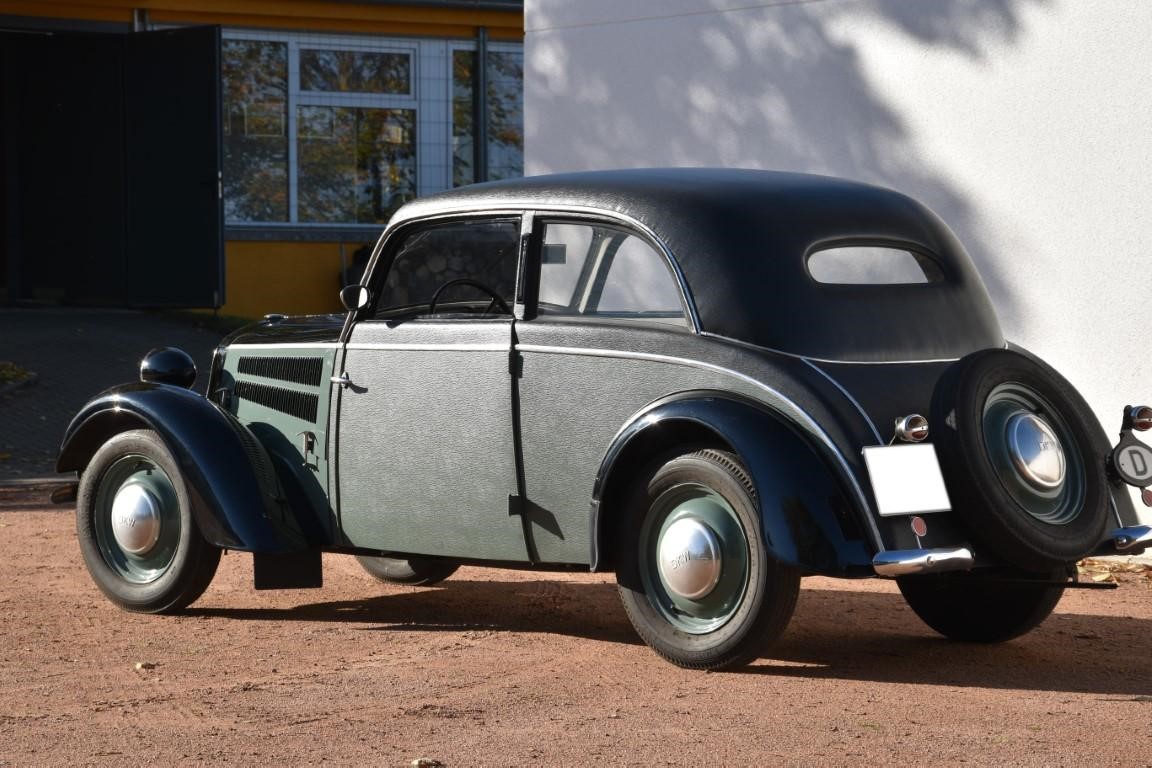
Wood body frame covered with leather(cloth)!
Of course quite modern front-wheel-drive; two-stroke engine (“rrreng-deng-deng-deng”).
Seeing the image it is all so obvious now 🙂
“Rrrreng-deng-deng-deng.” That is exactly how I remember them. You definitely put a smile on my face today.
For the record, the reason DKW used the 3=6 name was that it was a two-stroke and their logic was that twice the number of strokes (than a four-stroke) should equate to an engine with twice as many cylinders, i.e. a 3-cyl. 2-stroke of a given size should be equivalent in power to a 6-cyl. 4-stroke of the same size. It was pure PR to try to increase the appeal of the cycle which was cheaper to produce but rather smelly and inconvenient, having to add oil each time you refilled the petrol. It may sound like a logical comparison and it has some merit (bike engines were particularly adept at it, although environmentally unfriendly) but doesn’t take into account the greater efficiency of a 4-stroke. They dropped the name in 1958 when the DKW 3=6 transformed into the Auto Union 1000.
That should have said “…twice the number of firing strokes….”