
The Simplon Pass is a road through the Swiss Alps from Brig to Domodossola in Italy.

This route across the Alps lies roughly halfway between Bern in the north and Milan in the south.

Nowadays much of the road has been widened and parts straightened and Google Maps says you can drive the pass in 59 minutes, but my postcard was posted in 1965 and the photo looks to be taken about that time. The road then was a proper challenge and what I like about the postcard, apart from the view, is the activity in the car park.

They’ve all stopped to breathe in the cold, pure Alpine air, take some photos (not click click click on their phones, but each image carefully chosen, only 24 or 36 exposures available on their rolls of film) and have a welcome cup of hot coffee in the Hotel Bellevue. Some will take on more fuel at the petrol pump there in the car park, some will tighten the ropes on their roof racks, others will top up their radiators, others just leave their cars to cool down – engines and brakes. Others are consulting their maps and comparing notes with fellow travellers. All have a sense of achievement at getting to Simplon itself.
There are only three British cars in the picture and I like to think that the Triumph and Jaguar are British-registered and travelling together. Has the Jaguar started to pull out, but then the well-dressed woman sitting in the back remembered something and jumped out, leaving her door open, to tell their friends in the TR3 that they’ve decided to go on ahead and they’ll all meet up again tonight in the hotel bar in Milan?
But it’s the third British car that really fascinates me. What is an Austin A35 doing up in the Alps? Who was brave enough to imagine that they could drive from Calais to Italy over the Alps in an A35? Bravo! Oh, it has to be a British-registered car surely?


‘A universal vehicle for town or country, business or pleasure, passengers or goods’. And we might add ‘and for crossing the Alps’.
There’s another British vehicle in the picture, but not a car. The Standard Atlas van would have been quite a handful of the pass, and I hope there were not many hairpins as the all enveloping bodywork hid much if the front wheels and made the turning circle huge.
The A35 Countryman (if it has a roof vent, it would be a van converted to save Purchase Tax, but the roof rack hides this) may well be an A30 as the grill appears to be chrome, rather than the painted grille of the A35.
The two cars looking like Vauxhalls are actually Opel Records, which I don’t think were ever sold in the UK.
There is a pale coloured car which seems to be a BMC Farina (Austin Cambridge/Morris Oxford) and two cars to its left is another Farina design which could be a Peugeot, Simca , Fiat or Seat – they all looked the same. Any experts to identify which?
Sorry, the spellchecker changed “Rekord” to “Record” in the above comment.
So that’s what it is! I did wonder. I thought maybe a Renault. Yes I noticed the lack of wheel arches. I must look up the Standard Atlas. Thanks 🙂
I knew some people bought the van and converted it, but didn’t know about the roof vent or the painted grill. Thanks.
True, the Opel driving along the road and passing the fuel pumps is a Rekord but the one in the foreground is not a Rekord but its bigger brother, the Kapitan, most recognisable from its shallower grill. Also, it’s partly obscure and slightly distorted but it looks like another Rekord is being fuelled at the pumps.
The white car between the FIAT 600 and the TR (which may be a TR2 or a TR3A rather than a TR3: ‘can’t see from this photo as the front is obscured) is a Peugeot 404. The pale car between the Jag and the TR is too small to be a BMC Farina and looks more like a FIAT 1500 (though it’s difficult to be sure from this angle) which was styled in-house by Mario Boano, rather than Pininfarina. That only leaves two Renault Dauphines, a FIAT 1100 and an M-B Ponton to complete the set!
By the way, the photographers amongst them may have even had only 12 shots on each film as many did in those rather more austere times.
P.S. Neither Simca nor Fiat employed Pininfarina to style their saloons, although the latter did use that carrozzeria for their cabriolets and coupes (by contrast, Simca used Bertone for its pretty 1000/1200 coupe). In the 1960s, Seats were almost exclusively Fiats built under licence in Spain so their styling would be the same Centro Stile Fiat products as those of the Italian company. Yes the Peugeot 404 has a lot of similarity to the Austin/Morris Farinas but there are certainly differences, not least on both BMC cars the break in the waistline for the more pronounced fins and the swage line that curves downward below it.
P.P.S. The Fiat near the Jag could also be a 1300, essentially the same as the 1500.
According to the American F1 champion driver Phil Hill when attending an early 1960s Monte Carlo Rally, removing the air filter helps low powered engines over Alpine passes. He was asked for advice by the British crew of an Austin A40.
Ha! Interesting! Thanks for your comment. Yes Pat Moss competed in the Monte Carlo Rally in an A40 and there were quite a few entries in A35s.
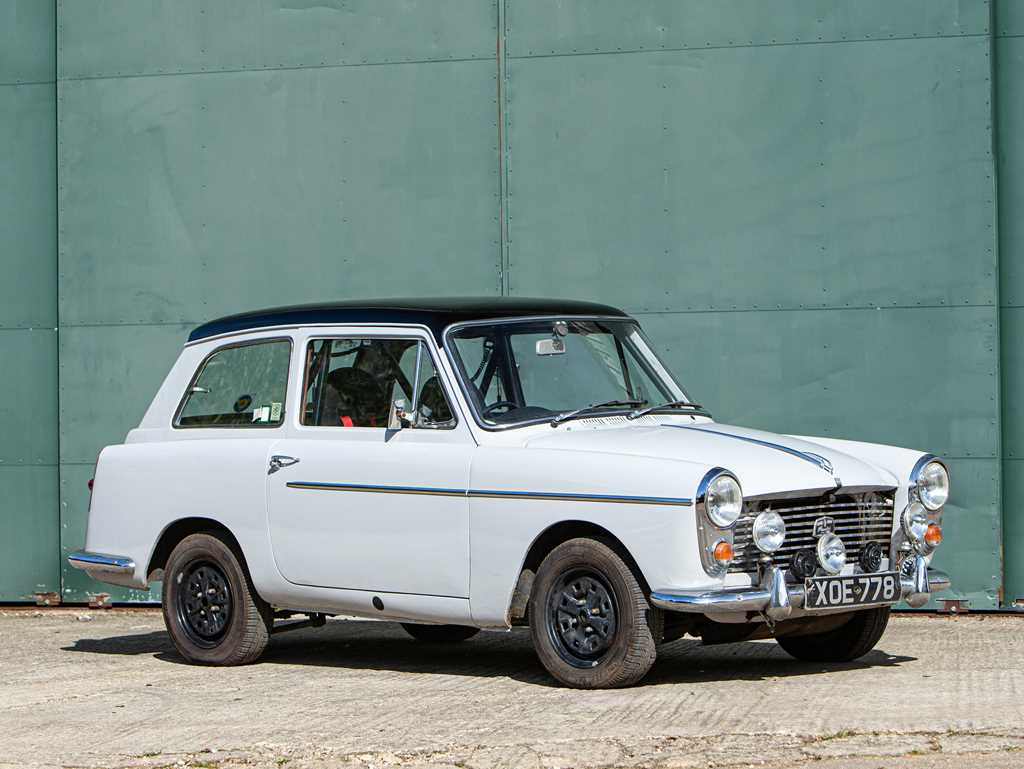
Pat Moss’s Austin A40 auctioned in 2021 for £45,000″.
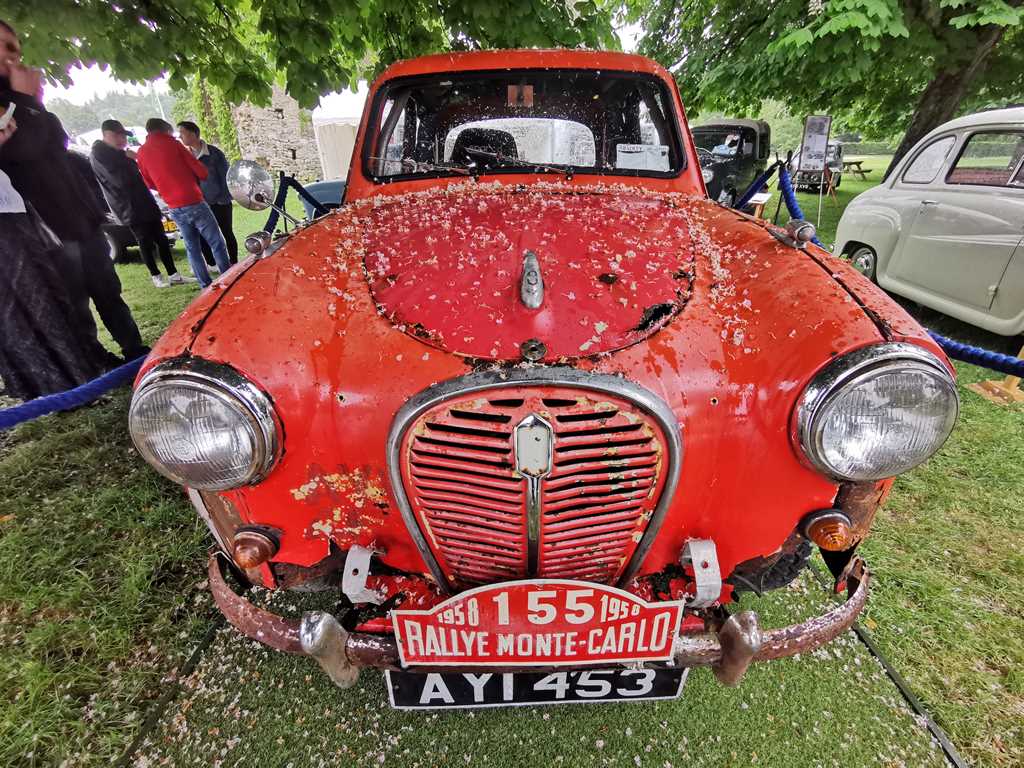
An A35 that once competed in the Monte Carlo Rally, recently found and to be restored.
I’d forgotten all about the Standard Atlas vans . I do remember the Leyland badged Atlas though after Leyland swooped on and took over Standard Triumph . Becoming the Leyland 15 (cwt) or 20 (CWT) so similar to the Austin J2 and Commer FC all had bodies over hanging the wheels wider than the track . They were spongey rides . We had an Austin J2 crew bus on our Flight at Brize Norton when I was in the RAF 1972 .The J2 and ( and Austin /Morris J4 ) the Atlas gave way to the Austin /Morris JU in the RAF which we got instead in 1973 . They never quite got the small van right did they ? The Sherpa (1974) took over the from the JU . It wasn’t great . Glad I only drove these things round the airfield . At a guess the White Farina is a Peugeot 404 going by the A pillar and back door windows .I know it’s a long shot but can’t see any evidence of quarter lights . The Dove Grey Farina is a Wolseley 16/60 I think because I think this has the “weird”shaped back light assemblies (that kink is not on any other Farina model’s back lights) and chrome tip with a kink . Love this blog .