
Port d’Envalira is, as we can see, pretty high up. In fact the highest road in Andorra runs through it and being up in the Pyrenees it is nowhere near the sea. ‘Port’ I suppose meaning ‘pass’. It’s not the place to find a nymph, but I think we have one.

According to myth Ondine was a nymph who fell in love with a man. In order to spend her life with him she morphed into a woman and married him. All was well for a while until she caught him in flagrante delicto with another woman. Ondine was none too happy and put a curse on her husband that caused him to permanently stay awake in order to control his breathing. ‘Ondine’s curse’. Otherwise known as congenital central hypoventilation syndrome.
Anyway, our little Renault, that looks so much like a Dauphine, is, I believe, an Ondine. This was a more luxurious and upmarket version of the Dauphine but was designated a Renault Ondine and not a Dauphine Ondine. We are used to car manufacturers marketing upmarket versions of their models with different marque names – Toyota/Lexus, Nissan/Infiniti – but can you think of any who changed the name of the model completely?


You can tell this is an Ondine because it has different wheels to a Dauphine, a chrome strip down its side (Maybe Dauphines got this later as there’s one in the image above) and rubber over-riders on its rear bumper. It also has a different and larger parking light on the front wing but we cannot see this clearly in the postcard.

Renault only made Ondines for two years; model years 1962 and 1963.
They differed from Dauphines in that they had four speed gearboxes (Dauphines got the same later), wheels with eight holes (sometimes twelve), a chrome strip on the rain gutters, a fancy parking light on the front wing which shone white around the edges of the red and gold badge, the word Ondine in an angular typeface on the front wings and the boot, rubbers on the rear over-riders, a chrome embellishment around the central rear number plate light, a chrome bar under the front the number plate connecting the left and right bumpers, reclining seats, a black dashboard, pockets on the front door cards and a steering wheel and column stalks that matched the body colour.


After seventy years it’s difficult knowing what’s what really. Many Dauphines have been modified over the years and similarly Ondine owners have sometimes replaced Ondine parts with Dauphine parts in order to keep their cars on the road. Even when they were new, Dauphine owners bought accessories that immediately made their cars non-standard. We saw this in the post Grilles in Cannes not long ago. And of course Renault themselves made changes to their cars, sometimes, no doubt, simply for supply reasons.

For all my sleuthing about on the Internet, our postcard car could well be a FASA Dauphine (made in Spain) or a Gordini. It’s a mythical creature after all and difficult to pin down.
Hi Bob,
From the script on the side, the postcard car is definitely an Ondine rather than a FASA or Gordini but what a shame it’s not a Henney Kilowatt, the American-built electric powered version that would be so appropriate for today! And on the subject, you ask “..can you think of any who changed the name of the model completely?”. Well, the beautiful 1959 Chevrolet at the pumps in this postcard give a clue to the answer: it was common for American manufacturers in the ’50s and ’60s to give completely different names to the same car based on trim level, rather than appending a name to a base model. So, for example this Chevrolet could be an Impala, a Biscayne or a Bel Air: each was advertised as a separate product but in general would have been referred to as simply the 1959 Chevrolet. Ford would have done the same with their models as would Chrysler, albeit to a lesser extent.
The Dauphine is a common sight in old movies, pictures, documentaries, and so on. In my home country, Brazil, it was built under license by Willys Overland.
Thanks, Bob for the reference to the Henney Kilowatt. And thanks also for some examples of different model names for basically the same car. Right under my nose! We’ve thought of another example at this end… Humber Super Snipe and Humber Imperial. All the best, Bob.
Hi Rubens, I did not know that but have looked it up and see Willys made a few different Renaults including a lovely Interlagos Berlinette (Alpine A108). I will now have a look through my collection and see if I have any postcards from Brazil. Many thanks for your comment. Bob.
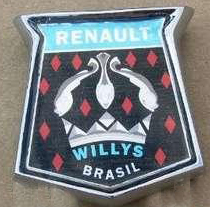
Ohhh, the Willys Interlagos have a special place in my heart.
When I was young, (mid-1980s) I owned a 69 VW Beetle, my best friend had a 1965 Willys Gordini, and his brother had a 1967 VW Karman Ghia. None of us had driver’s licenses but even though we used to cruise around town, with our yet-to-be-classics.
Good times.
Ha! Good times indeed. I’ve just read your piece called Renault Alpine. Very interesting! I will pass it on to my mate who has a 4CV and a modern Alpine (see my other blog Jimbo’s Renault 4CV Resto-mod)
All the best, I’m now going to look again at your blog 🙂
Bob