I’ve had this postcard (it is a postcard) for about four months. I bought it off eBay. It was described as “Unidentified Car – RP Postcard c1920s”. (RP stands for real photo). It mystified me for a long time but today I’ve cracked it.

To me this was a typical nineteen-twenties or thirties tourer. A large one to be sure – notice the three rows of seats, but otherwise unremarkable and because of the wire wheels, as opposed to wooden wheels, I would have thought a thirties car. However, I had absolutely no idea what it could be. Maybe you know already.
It does have very distinctive headlamp surrounds. Do we call them cowls? Bezels? Are these common words? They are to me, but I don’t often hear them. I used the word ‘squab’ the other day. My wife was amazed that I should come out with this weird word when she had never heard of it (and she upholsters antique chairs!). Seems common enough to me, though on reflection I’ve only read it in car reviews and then only a long time ago. Is it the same with bezel and cowl?
Anyway, this car has very distinctive ones. They reminded me of something much more modern but I couldn’t quite place it. The odd thing is, after I identified the car, I knew instantly what the ‘something much more modern’ was.
Another feature worth noting is that the radiator cowl (Ah yes, cowl again!) is the same colour as the body. ‘Colour-coded’ we might call it these days. And there are side lights on the scuttle. Where do these words come from?! I’m not even sure it is the scuttle, but that’s the word that sprang to mind. Anyway, the windscreen surround. Now that’s quite unusual I’d say, to have side lights there, in the thirties. Side lights on brackets up near the windscreen yes, but built into the scuttle? I don’t think I’ve seen many like that.
Let’s look at the badge… This made me think of the Overland; circular with something diagonal going on.

But although the badge looks vaguely similar we have lost the other unique features.
Then I came across a Studebaker Big Six.

OK, the one in the photo above is clearly not the same car, this is a two seater, but the badge looks similar and look! it’s got side lights in more or less the right place.

I poked about a bit on the Web and found other Studebakers. They generally fitted the bill but all had round headlights. So I put the postcard to one side and was on the look out for Studebakers with round headlights in squarish bezels.
It’s an interesting image though. Six men in a car. Who are they? Where are they? They are all wearing hats and the smug guy in white with the pith helmet suggests a colonial location. Is that a palace in the background? North Africa? I contacted the eBay seller to see if he had any more information, but his reply did not shed any light on the location. “The card came from an album I got from a local auction. The album appeared original and not one made up recently. It consisted of cards mainly before the 1920s including ones sent from France during WW1. The card you have does appear to be a bit random compared to other cards in the album.”
+++
Then I read about a ceramic mural on a wall in Calle Tetuán in Seville that featured a Studebaker. It’s still there and I saw it in 2013 without registering that the car was a Studebaker and didn’t even take a photo of it! Here’s a screenshot from Google Maps Street View.

I did look through all my old photos from that holiday to see if I had one of it. I had lots of the oranges (my wife makes marmalade so we came back with a suitcase full) and lots of the old buildings but not the mural. In fact the only car-related photo I took was this.

A Renault 5 in a tight spot.
Anyway, back to the mural which I did not photograph. It was created in 1924 and is an advertisement for a 6 cylinder Studebaker and if we look carefully there are the little sidelights and although the headlights are set in hexagonal surrounds, it does show that this was a design feature for Studebaker when most manufactures simply had round headlamps. So, confirmation I was on the right track!

It’s an interesting mural and has recently been restored. Five women in a car. Two with hats, three not. None looking where they’re going; all looking at Rodin’s naked Thinker. Why? And what’s the woman with her arm up doing?

More questions than answers but I was now convinced my postcard car was a Studebaker.
Then I came across a website called Momentcar and they have a Studebaker page. There you can see this photo of a Studebaker EG.

So it is a Studebaker! And when I saw that photo I knew what the ‘something much more modern’ was. But we’ll get to that in a minute.
Back in 2005 I visited the Studebaker museum in South Bend, Indiana . We were driving across the States at the time, but no family holiday is complete without a visit to a motor museum I feel. So I looked through my photos. Did I have a photo of a car with such headlight casings? (Another good word). Unfortunately not. All I had was this, of my youngest son, which is not very helpful.

If I had taken more photos I might have snapped this…

It’s still not exactly our car but it makes me think our car might be older than I thought. This is a 1917 Big Six.
+++
During the Thirties, Studebaker employed the famous industrial designer Raymond Loewy (and his team) to do some work for them and the relationship turned out to be a long one. One of the things he did was get rid of the old badge and replace it with something more modern. He was quite good at doing logos.

He designed quite a few Studebakers too, well perhaps not him but one of his design team. A bit like Michelangelo I imagine. So when I tell you he designed our humble little Hillman Minx, you can imagine the great man may not have done it all himself. Anyway, we do attribute those British Rootes cars with their wrap around Studebaker-like rear windows to Mr Loewy.

Some say it bears a resemblance to the 1953 Studebaker Coupe but apart from the window I can’t see much in common.

Another car he influenced, without actually designing, is not a Studebaker at all but a whole range of cars, a whole look of cars. These are what we call the Coke bottle cars. Here’s an extreme example….

But any car design where the line over the front wing drops after the front wheel and then rises again even higher over the rear wheel, we call a Coke bottle design. Lots of GM cars have this look and so, over in the UK, lots of Vauxhalls.

Here’s a Vauxhall Victor FD with a sleeping child in the front with a dummy in his mouth. Loewy did not design it, the car I mean, but he did design the Coke bottle, though this has nothing to do with anything really. Before Loewy redesigned the Coke bottle it already looked like a Coke bottle, so that’s not why we associate Coke bottle car design with Loewy.

Loewy’s bottle is the 1957 one. He had some front that man.
The first Coke Bottle Design car was Loewy’s Studebaker Avanti. Here it is…

Now, when I identified our postcard car as a Studebaker, I immediately thought Bingo! The Avanti! – that’s where I’ve seen those lights before. So I was a little surprised to find the first Avantis were round eyed.
However, we do find our squarish bezels on the face-lifted Avanti, so I reckon Loewy was wandering around the factory’s museum one day searching for inspiration and he saw the old Big Six. Ah, those bezels will do nicely…

Raymond Loewy didn’t only design cars and logos. He is known as the father of streamlining. He designed a streamlined locomotive for the Pennsylvania Railroad and streamlined buses for the Greyhound Bus company.


And he designed kitchenware. Why not.


Those Big Six light bezels are so versatile.
And those GM designers thought so too. Did you notice the Victor’s lights?

When researching postcards you come across some pretty surprising stuff. Do you know that some owners of Land Rover Defenders, those tough, macho, mudslinging four-wheel-drive, all terrain vehicles that get all bashed about and muddy, buy squarish tin bezels for their headlights at £31 each because “Forming part of the vehicle’s body and trim, the headlamp bezel adds a finishing touch to the aesthetic of your Land Rover.”

At first I thought that was a bit steep, but then I saw on ebay a Le Creuset Raymond Loewy Coquelle. That’s a used orange casserole dish. £275.

Postcards are cheaper.
What a nice story. ‘Studebaker’, from question to answer and quite a few delightful thoughts and facts on the way. I myself had looked at the location of the louvres in the bonnet and the ridge on the fenders, which in my opinion both are more secure for an identification than small (extra?) side lights. Wonderful that you found the Avanti and Vauxhall headlamp surrounds.
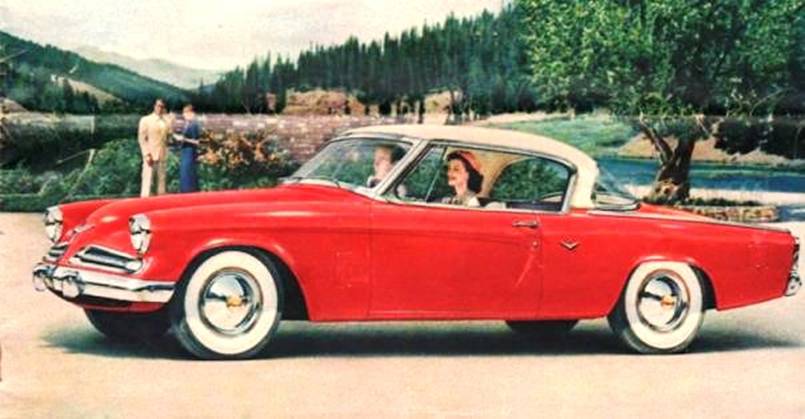
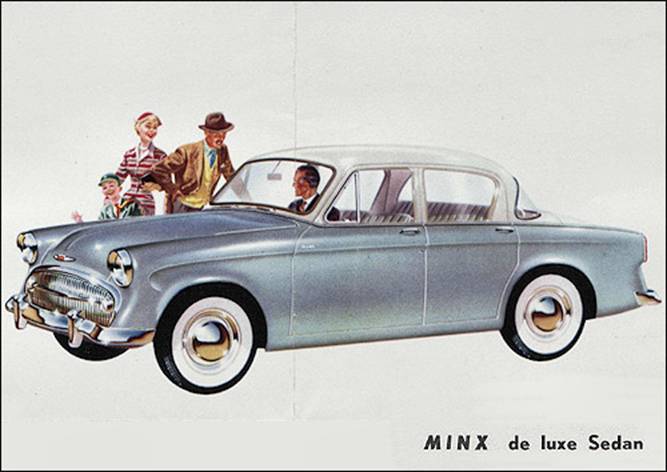
Now the Hillman. I’m not sure of the 1964 Super Minx as seen on your photo, but the smaller 1957 Minx obviously was a design from the Loewy studios. Just compare! Apart from the rear window you mentioned, the way in which the bonnet merges into the windscreen base (where the wipers are) is very much the same on both cars. If the Studebaker isn’t a lengthened Hillman, the Hillman is a shortened Studebaker.